


My experience with:
Marathon - Season 1
Posted May 2026
Introduction
There is a lot of noise surrounding Marathon 2026. I have never seen a more aggressively negative reaction to a video game release. Even beyond the incessant negativity, the game has garnered a reputation as an ultra-hardcore experience that is practically impenetrable to the casual player.
I’m happy to report that the game’s difficulty is greatly exaggerated. I have played Marathon for about 60 hours (13 of which in the server slam), and I’ve loved every minute of it.
Part 1 - Into the Belly of the Beast
Marathon’s gameplay is electrifying, with each run leaving you with a new story to tell about how you just barely made it out alive or how you went down fighting in a blaze of glory.
This is a game where you will die frequently and, in that process, lose all of your loot. However, Marathon also showers you in loot right from the get go – every faction level and seasonal level rewards you with progressively stronger gear and I have spent the entirety of season 1 with a backlog of faction rewards that I can’t even claim due to my vault already being full.
For this reason, this game feels welcoming to new players once they let go of their attachment to their loot and focus on Marathon’s real progression process: gaining knowledge. With each run you will learn more about the map you’re playing on, the locations where bots and loot spawn, the safest routes between points of interest, PVP hotspots, and the best way to utilise the tools at your disposal. Half the battle in Marathon is decided before you pull the trigger.
Marathon Season 1 offers a robust suite of content. You have 6 factions to progress, each with their own upgrade trees that give you better stats and loot to use all season. 4 of these factions also feature priority contracts, which act as the main source of the narrative. The codex entries unlocked through these contracts are excellently written and set the stage for a very interesting story which I hope to see unfold over future seasons.
'Half the battle in Marathon is decided before you pull the trigger.'
You also have 4 maps to master, each progressing in difficultly. The first map, Perimeter, acts as a training ground for Marathon’s more gruelling challenges but still feels incredibly intense when you first start out. The tension that builds when you hear footsteps or gunfire in your vicinity and the chaos that ensues when PVP combat begins is key to the experience of Marathon. Even the most boring objective can feel exciting when you have to keep your head on a swivel to check for other players, and playing solo feels straight up like playing a horror game.
Not that UESC bot enemies are pushovers either, these NPCs have some of the most enjoyable AI that Bungie has put out since the elites from the original Halo series. They dynamically push your position, fall back to protect points of interest, alert other enemies to your presence, and generally do everything they can to mess you up.
On that note, I have to say just how much Marathon takes me back to the feelings I had playing the old Halo games. This is the first multiplayer game to keep me invested since Halo Reach launched in 2010. Exploring Tau Ceti IV just oozes the same atmosphere that I felt exploring New Mombasa in Halo 3: ODST, and PVP encounters successfully deliver the same adrenaline I used to feel throughout the original trilogy.

Part 2 - Fourth Floor: Tools, Guns, Keys to Super Weapons
So where does the hardcore reputation come from then? Well, apart from the steep learning curve, there is the endgame content which, in Season 1, revolves around Cryo Archive. This incredibly complicated fourth map houses the best loot and the most brutal combat encounters. In my 60 hours of Marathon I only braved Cryo for 3 hours, during which I failed to extract once and lost all of my high tier loot which I had collected throughout the entirety of the season (there is a reason that the community affectionately calls Cryo Archive ‘the loose everything factory’).
Cryo features multiple map exclusive mechanics to learn and requires certain parameters to even be able to extract, and that is just the tip of the iceberg for the secrets is has in store. Despite the obvious challenges, I was hooked on Cryo Archive – in that 3 hour stretch I found more loot than I had done in my previous 40 plus hours. PVE encounters were frenetic action-packed experiences and the PVP was extremely challenging but highly engaging throughout. The only reason I stopped playing is that I simply ran out of time as Cryo Archive is only available on weekends, and the weekend I finally tried it was the last weekend I had free before the conclusion of Season 1.
Whilst my experience has been overwhelmingly positive, I can’t help but notice the experience of players who have dedicated more time to the game seems to be different. Reddit, for example, is home to countless complaints about the game being too difficult and the PVP being full of players so good that newcomers won’t stand a chance. The issue seems to stem from the level-based matchmaking, where once you hit the high levels the pool of similarly levelled players gets smaller, so level 80 players can end up being matched with level 150 players, etc. This may indicate a problem with Marathon’s endgame as it stands, but I can’t comment on it directly as it simply didn’t affect me.
'The only reason I stopped playing Cryo is that I ran out of time'
If you’re interested in this game and, like me, can only dedicate a handful of hours a week to it, then you might actually have a much easier and less ‘sweaty’ experience than those putting in hundreds of hours. In a weird way, I think that Marathon is actually a fantastic experience for the casual player, provided they are open to meeting the game half way and learning it’s mechanics.

Part 3 - Cross-Purposes
The gameplay, visuals and world of Marathon are wonderfully synergised. You play as a ‘runner’, an artificially created shell which houses a real human consciousness (you). Every time you die in game, your shell is destroyed but your mind is safely restored and uploaded to a fresh shell. In lore, you the price for your digital immortality by completing contracts for various factions in an effort to wipe out insurmountable debt.
The story in Marathon is also enticing. After a mission to colonise a new planet, all of the colonists seemingly vanished and it is up to you, under the ‘employment’ of various factions, to find out exactly what happened. This links into the progression systems, where you are issued contracts from factions for both story and loot rewards.
The game mechanics are ingrained into the lore and the extraction aspect oddly fits with the original games where you would be teleported into each mission and then teleport out at the end terminal once your objective has been accomplished.
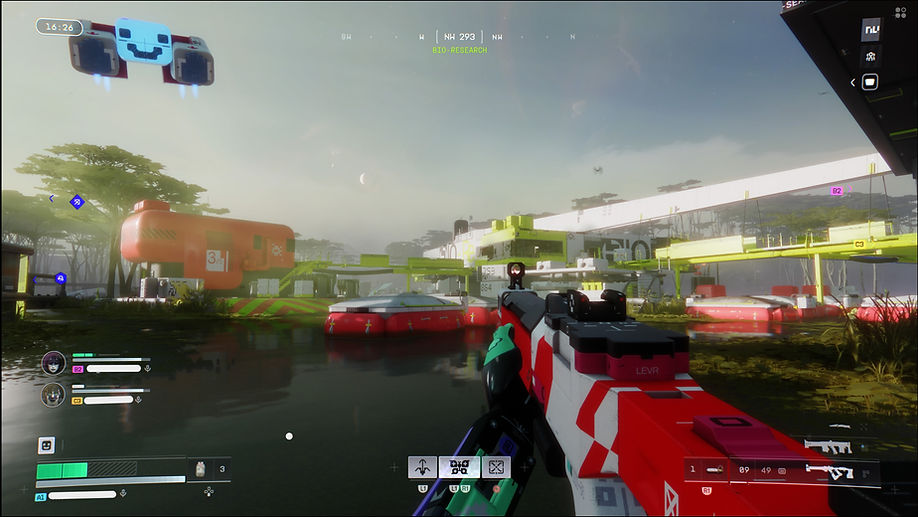
Marathon’s art style is surprisingly polarising. Back in 2023 I wrote about how much I was taken with the art style displayed in the initial reveal trailer and since then I have only seen it evolve into the beautiful game available today. It clearly isn’t for everyone, but I love this art style, it combines so many things I like into one cohesive whole such as cyberpunk, graphic design, and prioritising stylised visuals over realism. The in-game presentation is gorgeous, from the carefully crafted interiors to the harsh outdoor environments of Tau Ceti IV. I was particularly impressed with the weather effects – storms cover the map; water pours off surfaces and creates puddles on the ground. The skyboxes give the same sense of wonder that Destiny 1 gave me in 2014, and the bold 3D-printed buildings really sell the narrative that this was a human colonisation effort sponsored by massive corporations.
'The soundtrack kicks in just at the right moments to elevate the experience.'
When Marathon was first announced, the plan was that all players would have a fully customisable runner (player character). The later news that the game had switched to a hero shooter direction was massively disappointing as the concept of creating my own runner seemed so exciting in a world with such a rich visual style. However, I can’t help but feel like the move to set character classes was the right call. Each class has its own distinct gameplay style which is easily recognisable in a firefight, and learning how play each class effectively is a joy. There is even some very interesting lore explaining why each ‘shell series’ exists, such as how Thief has the face and voice of the lead science director of the company that invented shells, with the codex entry theorising the advantages of this choice. I do hope to see more customisation options in the future than the skins we have now, so we will see what future seasons bring.
Before I move on, I need to briefly mention how good the soundtrack is. Prior to launch this was a particular point of concern for me now that Bungie is without both Martin O’Donnell and Michael Salvatori, but Ryan Lott stepped up to the plate to deliver a pulse pounding soundtrack that is seamlessly integrated into the whole game. The game is mostly quiet outside of diegetic sounds, which are fantastic throughout, but the soundtrack kicks in just at the right moments to elevate the experience.

Part 4 - Flawless Cowboy
Whilst I’m giving Marathon a glowing recommendation, I do have some criticisms that I hope are addressed in future updates.
During Season 1, I managed to fully complete only 1 of the 4 available faction questlines. This was largely because priority contracts are level gated, meaning that I would frequently have gaps where my faction rank wasn’t high enough to access the next set of contracts. As someone with limited time to game, I find this kind of thing annoying because it is an arbitrary barrier to completing story related content, which is especially frustrating in a game where faction progress resets each season.
This setup makes it very difficult for the average player see the faction stories through to the end each season. Granted, I could have specifically targeted getting more faction reputation to unlock the relevant contracts faster, but therein lies another problem: playing specifically to see numbers go up is boring versus simply playing the maps/game modes you find enjoyable.
Furthermore, I think that the priority contract objectives get repetitive after a while. I can only speak for the content I completed, but many involve scanning something then traversing the whole map to scan something else and then exfiltrate. Whilst this initially creates wonderful moments of tension, after a while it becomes routine. For future seasons I would like to see more creative objectives: perhaps a unique boss or enemy encounter could spawn based on your actions, or you could access locked off areas of the map for some content unique to that contract.
'It is difficult for the average player see the faction stories through to the end each season.'
I’ve seen a lot of people requesting some form of PVE only mode or campaign. The phrase ‘How can a parent with 2 children even make time to play this’ is often asked and it seems like potential players are being put off by Marathon being multiplayer only; I have mixed feelings on this:
You can very easily play this game casually once you get over ‘gear fear’. Playing each match for the fun of it and not obsessing over upgrade trees and loot makes for a much more enjoyable experience in my book. Looking back, I didn’t spend hours playing Halo 3 after school every night because I wanted to max out my level, it was because the game was a joy to play. You also gradually unlock a plethora of free daily loot from the game’s armoury, so Marathon does get less punishing as you progress.
On the other hand, I definitely think Marathon would benefit from adding a PVE focused mode. This would allow new players to learn every aspect of the game at their own pace. However, I don’t think simply making PVE variants of the existing maps is the way forward as they simply aren’t designed to be played this way and it would make for a dull experience.
Ideally, I would like to see specific PVE missions in unique locations which are built around the same extraction mechanics as the multiplayer, although I appreciate the immense amount of resources this would take. Maybe there is a smarter way to implement more beginner friendly experiences and cooperative events into the extraction shooter loop, but I’ll leave that for Bungie to figure out!
Additional comment: the same day I finished writing this review, Bungie posted an article reflecting on Season 1, and discussing plans for future seasons. It is worth highlighting that less grindy progression, smoother onboarding, and potential PVE only content are all mentioned. It is too soon to say if mine and other's criticisms will be addressed, but it certainly looks promising.
Part 5 - Conclusion
Marathon is a game I was cautiously optimistic for and that managed to completely surpass my expectations. I am genuinely excited to see what Season 2 brings to the table and I sincerely hope that Bungie turn this game’s reputation around and attract a host of new players. If this isn’t the case and the game slowly dies out, then I’m certainly glad I took the time to play it whilst it lasted.
Until next time…
